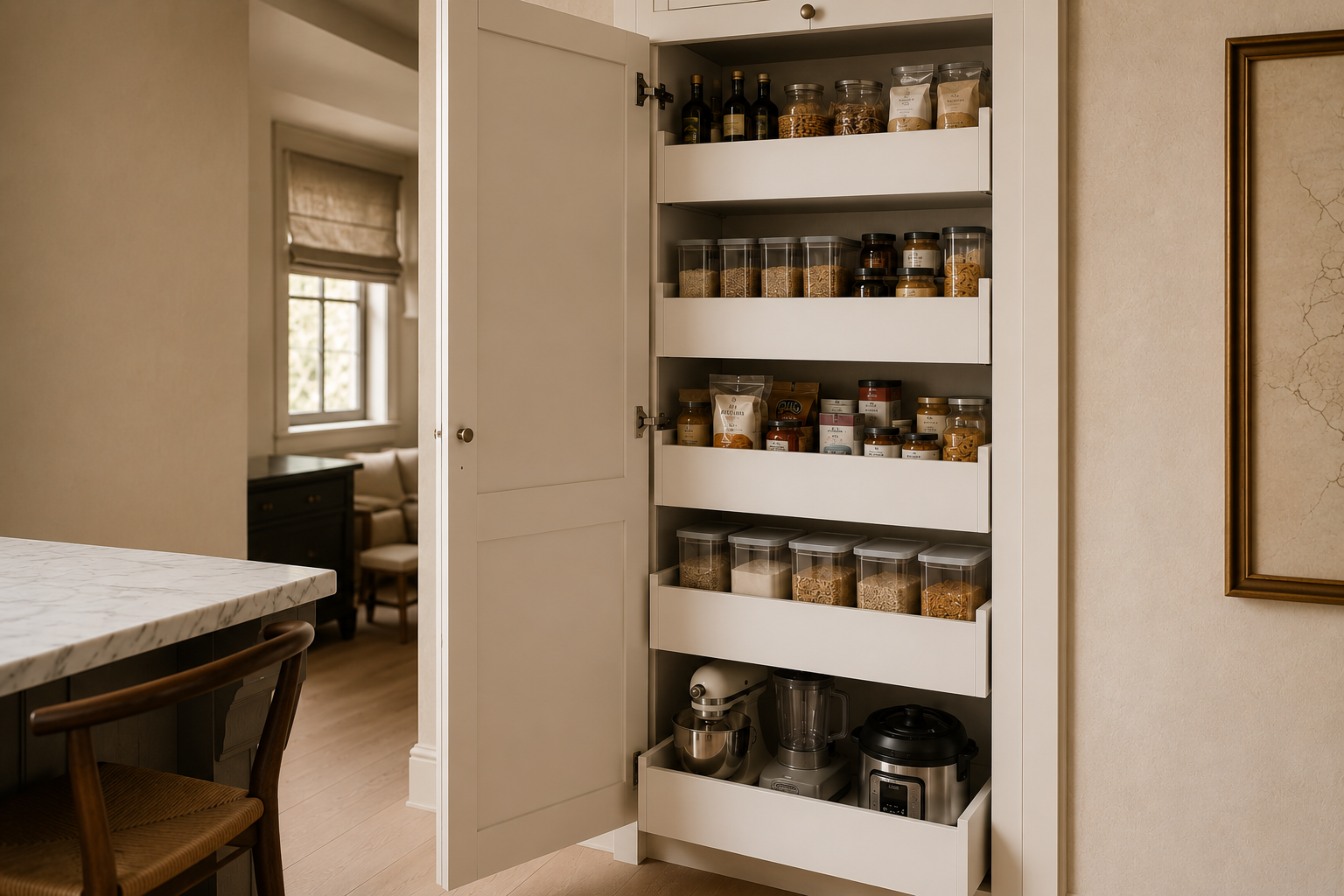
The biggest organization mistake I made wasn’t buying the wrong organizers. It was trying to organize a home that wasn’t designed to function.
Design your storage before you organize your stuff.
It sounds backwards.
Most of us think organization starts with baskets, bins, drawer dividers, or matching containers.
I used to think that too.
Every time a space became cluttered, I bought another organizer.
A few matching bins for the pantry.
Another basket for the living room.
A container for the toys.
For a while, it worked.
Then life happened.
The clutter came back, and I found myself buying more organizers for the same spaces.
Eventually I realized I wasn’t fixing the problem.
I was organizing a home that simply wasn’t designed to function.
Once I started designing better storage instead of buying better organizers, our home became easier to keep tidy, calmer to live in, and surprisingly, I needed far fewer organization products.
Instead of asking,
“What organizer should I buy?”
I started asking,
“Why doesn’t this space function well in the first place?”
That one question completely changed the way I design our home.
Storage Isn’t the Problem—Functional Storage Is
When people tell me they don’t have enough storage, I usually believe them.
The problem is that many homes simply weren’t designed with enough functional storage in the places we actually need it.
Yes, deep lower kitchen cabinets can become black holes.
But the issue often goes much further than that.
Many homes don’t have a pantry.
They don’t have a mudroom.
They don’t have a linen closet.
They don’t have a coat closet near the front door.
They don’t have built-ins in the living room.
Instead, we try to solve those missing spaces by buying furniture that wasn’t really designed to store anything.
A decorative sideboard.
A narrow console table.
Random open shelving.
Cube organizers.
Then we buy baskets and bins to make those pieces work.
Instead of asking,
“What organizer do I need?”
I started asking a different question.
“What kind of storage is this room actually missing?”
That simple shift changed everything.
Maybe the answer is replacing a decorative sideboard with a built-in bookcase that includes lower cabinets and interior drawers.
Maybe it’s turning an empty wall into floor-to-ceiling storage.
Maybe it’s adding interior drawers behind cabinet doors instead of stacking bins on shelves.
I always start by thinking about what our family actually needs to store.
Only then do I think about how to make that storage beautiful.
Because the goal isn’t simply to add storage.
The goal is to create storage that looks like it was always meant to be part of the room.
When beauty and function work together, organization becomes much easier because your home is finally working with you instead of against you.

Drawers Changed Everything
If you’ve spent any time on Pepper Lu Design, you’ve probably heard me say it before:
Drawers are almost always the answer.
Over the past few years we’ve added drawers almost everywhere we could.
- Interior drawers behind cabinet doors
- Deep kitchen drawers
- Laundry drawers
- Toe-kick drawers
- Drawer organizers
- Furniture with hidden storage
- Bedroom storage drawers
Instead of digging through shelves, everything comes to you.
Nothing gets buried.
Nothing gets forgotten.
Everything is visible the moment you pull the drawer open.
One of my favorite upgrades has been adding interior drawers inside IKEA cabinet systems. You keep the clean look of cabinet doors while gaining the convenience of drawers inside.
Today our home feels significantly more organized, even though we actually own fewer organizers than we used to.
Some links in this post are affiliate links. If you make a purchase, I may earn a small commission at no additional cost to you. I only share products I personally use, love, or would recommend to family and friends. Read my full disclosure policy here.

I Still Use Bins—Just Differently
This isn’t a post about throwing away every storage bin you own.
Bins still have an important job.
I use them for:
- Seasonal decorations
- Sports equipment
- Emergency supplies
- Basement backstock
- Holiday décor
Notice what these all have in common?
They’re things we don’t reach for every day.
For everyday living, I almost always choose drawers over bins.
Bins are excellent for grouping similar items together.
I simply prefer those bins to live inside drawers or behind cabinet doors instead of becoming part of the room’s visual clutter.
Even Kids Don’t Need to See Everything They Own
One of the biggest organization trends over the last decade has been open toy storage.
Rows of colorful bins.
Cube shelves.
Large IKEA Trofast systems.
The idea makes sense at first.
Kids can see every toy they own.
Everything has a place.
Cleanup is simple.
But after watching my own boys play, I started wondering if seeing everything was actually the problem.
Just because children can see every toy they own doesn’t mean they benefit from seeing every toy they own.
When dozens of toys are always visible, the room never really feels calm.
Visually, it’s clutter—even when everything has been “put away.”
I also noticed something else.
When there are too many choices, my boys often bounced from one toy to another without really settling into imaginative play.
Fewer visible choices seem to encourage deeper, more creative play.
Hide the Bins, Not the Organization
I still use bins to organize toys—but they’re grouped intentionally.
Every type of toy has its own home.
Hot Wheels have their own bin.
Monster trucks have another (otherwise the monster trucks quickly crush the Hot Wheels!).
Wooden trains stay together.
Train tracks have their own bin.
Magnetic tiles have another.
Building blocks.
Animal figures.
Art supplies.
Everything has a dedicated home.
The organization is still there.
The difference is that those bins live inside drawers or behind cabinet doors, not sitting out in the room.
When someone walks into the playroom, they don’t see dozens of colorful bins competing for attention.
They simply see a calm space that’s ready to be played in.
For babies and toddlers, I also love keeping just a small selection of toys on an open shelf while everything else stays tucked away.
Every week or two, I rotate a few toys.
Nothing new was purchased.
Nothing was added.
Yet somehow everything feels fresh again.
When my one-year-old opens a drawer or cabinet, it’s almost like discovering treasure.
He loves opening a drawer to see what’s inside.
Sometimes I think kids enjoy the surprise just as much as the toys themselves.
If you’re using bins for toys, I’d rather see those bins tucked neatly inside cabinets than becoming the room’s décor.
A calm room benefits everyone—not just the adults.
The adjustable IKEA cabinet system I recommend for hidden toy storage.

Furniture Should Earn Its Place
Whenever I buy furniture, I ask one simple question.
Does it earn its place?
Can it hide clutter?
Can it add storage?
Can it improve how we use the room every day?
Instead of a decorative console, maybe it’s a built-in bookcase with cabinets below.
Instead of open shelving, maybe it’s closed cabinetry with interior drawers.
Instead of a coffee table that simply holds decorations, maybe it’s one with hidden storage for board games and blankets.
Beautiful furniture and functional storage shouldn’t be two separate goals.
The best pieces accomplish both.
Build Better Storage Before Buying Better Organizers
Before I buy another organizer, I ask myself three questions.
Can I add a drawer instead?
Interior drawers behind cabinet doors completely transform deep cabinets.
Can furniture solve this problem?
Would a storage bench, cabinet, or built-in solve this permanently instead of another basket?
Do I actually need less?
Sometimes the answer isn’t another organizer.
Sometimes it’s owning fewer things.
One less duplicate.
One less kitchen gadget.
One less impulse purchase.
Buying less often creates more space than buying another organizer ever could.
Design First. Organize Second.
The biggest mindset shift I’ve had is this:
Stop organizing a home that wasn’t designed to function.
Instead, improve the function first.
Then organization becomes easy.
You’ll need fewer bins.
Less maintenance.
Less visual clutter.
And you’ll spend far less money trying to stay organized.
I’ve realized I wasn’t looking for a more organized home.
I was looking for a calmer one.
Once I started designing for calm instead of simply storing more, everything else became easier to keep organized.
The goal isn’t to hide your life.
It’s to reduce visual noise so the things you use every day have room to shine.
Beautiful homes aren’t created by perfectly matching baskets.
They’re created by thoughtful design that supports real life.
Continue Reading
If this philosophy resonates with you, you may also enjoy:
- Function First, Beauty Second
- How I Created Pantry Space Without a Pantry
- Why Drawers Beat Baskets Every Time
- I Replaced My Laundry Hampers with Hidden Drawers (and I’d Never Go Back)
Free Guide
If you’re trying to create a home that’s simpler, calmer, and filled with purchases you’ll actually love for years, download my free guide:
The Buying Filter
Five questions to run before anything new comes into your home. If it doesn’t pass the filter, it doesn’t come home.
Ready to Go Even Deeper?
If you’re ready to rethink the way you shop for your home, my complete guide shares the purchases I’ve stopped making, what I buy instead, and the principles that have saved us thousands while creating a home we truly love.