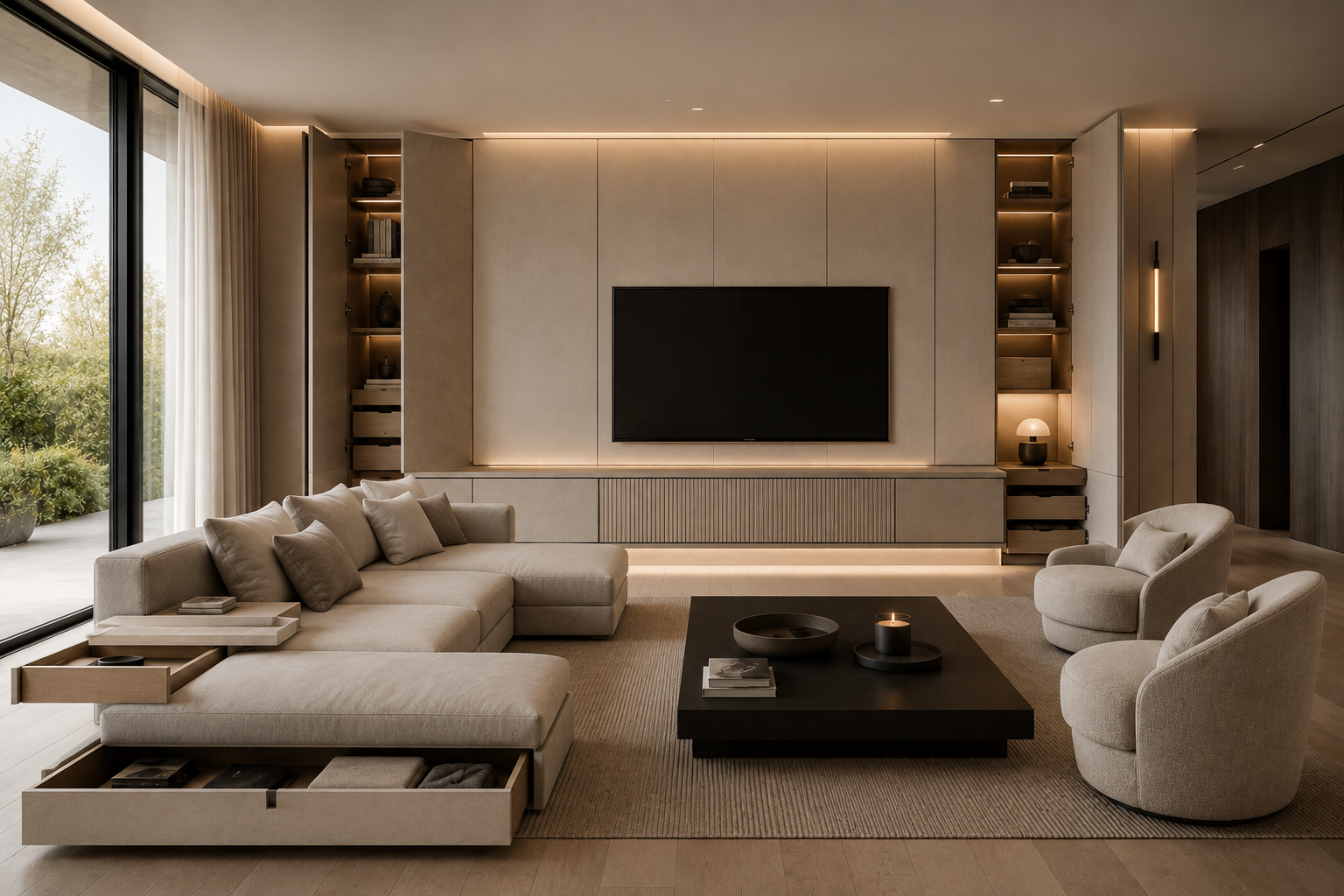
Luxury isn’t about having less. It’s about having less that works better.
Search Pinterest for minimalist luxury living room ideas and you’ll find gorgeous spaces filled with creamy linen sofas, oversized windows, and perfectly styled coffee tables.
They’re beautiful.
They’re inspiring.
But many of them don’t actually look like homes people live in.
There’s nowhere to hide the toys.
The coffee table is too small for family game night.
The shelves are styled perfectly but don’t hold anything useful.
The room photographs beautifully, but six months later it’s covered with baskets, bins, and furniture added simply to make it function.
I’ve learned that the most luxurious homes aren’t the ones with the least furniture.
They’re the ones where every piece has a purpose.
That’s the difference between decorating a room and designing one.
At Pepper Lu Design, I believe in one simple philosophy:
Function First. Beauty Second. Always Both.
Because the most beautiful rooms are the ones that continue working long after the Pinterest photo is taken.
1. Start With One Incredible Sofa
If there’s one place to invest in your living room, it’s the sofa.
Everything else can evolve over time.
A quality sofa immediately elevates the room because it’s where your eye naturally lands.
Instead of replacing a trendy couch every few years, choose one you’ll love for the next decade.
Look for:
- Linen or high-quality performance fabric
- Deep, comfortable seating
- Neutral colors
- Simple, timeless lines
- Excellent construction
A room doesn’t need three accent chairs and twelve decorative pillows to feel luxurious.
One incredible sofa will always outperform several mediocre pieces.
Buy the sofa you’ll still love in ten years—not the one everyone is buying this year.

2. Design Around How You Actually Live
Before buying a single piece of furniture, ask yourself one question:
How does my family actually use this room?
Not how Pinterest uses it.
Not how a model home uses it.
How you use it.
Do you gather here every evening?
Do your kids build train tracks across the floor?
Do you work from the couch?
Do you need hidden toy storage?
Do you eat pizza and watch movies together on Friday nights?
The answers should determine the furniture—not the other way around.
This is where so many living rooms go wrong.
People buy a beautiful coffee table that’s too small to actually use.
A console with no storage.
Shelves that only hold decorations.
Accent chairs no one ever sits in.
The room looks finished.
But it doesn’t function.
When we design around real life first, something interesting happens.
We actually need fewer things because every piece works harder.
That’s what makes a room feel luxurious.
3. Hide the Clutter Before You Decorate
One of the biggest differences between a luxury home and an average one isn’t the furniture.
It’s what you don’t see.
Most people buy baskets after the clutter appears.
I prefer designing storage before I need it.
One built-in cabinet with interior drawers can replace:
- Decorative baskets
- Open shelving
- Plastic storage bins
- Side tables filled with miscellaneous items
Closed storage creates visual calm.
When everyday life disappears behind cabinet doors, the entire room feels larger, quieter, and more luxurious.
Not because you own less.
Because you see less.
This is why I often use IKEA kitchen cabinets with drawer interiors in living rooms instead of traditional furniture.
They work harder.

4. Let Materials Be the Decoration
One mistake I see repeatedly is trying to create warmth with accessories.
Instead, create warmth with materials.
My favorite timeless palette includes:
- White oak
- Limestone
- Travertine
- Linen
- Cotton
- Wool
- Marble
- Aged iron
- Antique brass (used sparingly)
When your materials already have richness and texture, you don’t need shelves full of decorative objects.
The room feels warm because of what it’s made from—not because of how much is sitting on every surface.
5. Buy Bigger Pieces, Not More Pieces
Luxury rooms rarely feel luxurious because they’re full.
They feel luxurious because they’re intentional.
Instead of filling a room with lots of small furniture, choose fewer, larger pieces.
Think:
- One oversized coffee table
- One substantial sofa
- One large rug
- Floor-to-ceiling curtains
- One oversized piece of artwork
I also think about visual weight.
One reclaimed wood coffee table has more impact than two tiny nesting tables.
One oversized linen sofa feels calmer than a sofa surrounded by multiple accent chairs.
One large piece of art often creates more impact than an entire gallery wall.
Your eye has fewer objects to process, which naturally makes the room feel calmer and more expensive.
6. Every Surface Should Reset by the End of the Day
One habit has probably done more for making our home feel calm than any piece of furniture I’ve ever bought.
Every evening, our home resets.
Before bed:
- The kitchen counters are clear.
- The island is clear.
- The dining table is completely empty.
- The coffee table only holds the items that permanently belong there.
Does it stay that way all day?
Absolutely not.
We have kids.
There are toys, snacks, backpacks, projects, laundry, and all the little things that naturally accumulate throughout the day.
The difference is that everything has somewhere to go.
If something doesn’t have a permanent home yet, it goes into one of our designated holding spaces.
For us, that includes things like:
- A Tomorrow Basket for things I need to deal with the next day.
- An Upstairs Basket for items that belong on another floor.
- A designated place for paperwork.
- A catch-all spot for odds and ends that haven’t found their permanent home yet.
The important part is this:
Even the baskets have a home.
They’re temporary holding places—not permanent clutter.
Without systems like these, random items slowly spread across every countertop and table until the house begins to feel chaotic, even when it isn’t actually dirty.
One of the easiest ways to create a luxury feeling isn’t buying another piece of furniture.
It’s waking up to clear surfaces.
That visual calm changes how your entire home feels.
A well-designed home should be able to reset in just a few minutes because everything already has a place.
Luxury isn’t having spotless counters every minute of the day. It’s having a home that can easily return to calm.
7. Don’t Settle
One of the biggest mistakes I see isn’t buying expensive furniture.
It’s settling for furniture you already know isn’t quite right.
We’ve all done it.
“This will work for now.”
“It’s close enough.”
“I’ll replace it eventually.”
The problem is that “eventually” almost always comes.
Now you’ve paid for the wrong piece.
You’ve lived with the frustration of it not functioning the way you wanted.
Then you’ve paid for the right piece anyway.
That’s not saving money.
That’s buying the same space twice.
Some of my favorite pieces in our home exist because I couldn’t find exactly what I wanted.
So I built them.
If you’re handy, don’t be afraid to create the piece yourself.
Trust me—you’ll probably be even more proud of that piece because it was designed specifically for your family and your home.
If building isn’t your thing, don’t settle.
Look beyond the big-box stores.
Search Etsy.
Reach out to a local craftsman.
Commission a custom piece.
Or simply wait.
I’ve waited months—and sometimes years—for the right piece to come along.
I’ve never regretted waiting.
I’ve regretted settling.
The homes that feel timeless aren’t filled with furniture that was bought quickly.
They’re filled with pieces that were chosen carefully.

What I Skip
These aren’t rules.
They’re simply purchases I’ve found don’t earn a place in our home.
- Fake plants
- Tiny decorative objects
- Trendy furniture that dates quickly
- Multiple small accent tables
- Excess throw pillows
- Decorative baskets without a purpose
- Open shelves filled just to fill space
- Furniture that looks beautiful but doesn’t function
Buying fewer of these has made our home feel lighter, calmer, and surprisingly more luxurious.
The Pepper Lu Design Rule
Before bringing anything into my home, I ask one simple question:
Has this earned its place?
Does it solve a real problem?
Will I still love it in ten years?
Is it made from quality materials?
Does it make our home function better?
If the answer isn’t yes, I wait.
I build it.
I customize it.
I keep searching.
Because I’ve learned something after years of renovating and designing homes:
Waiting for the right piece almost always costs less than settling for the wrong one.
Furniture should earn its place.
Storage should be designed before it’s organized.
Every surface should be able to return to calm.
And every room should make everyday life easier.
To me, that’s what minimalist luxury really means.
Not owning less for the sake of owning less.
But choosing fewer, better things that you’ll love for years to come.
Because the most beautiful homes aren’t the ones that look untouched.
They’re the ones that work so well for the people living in them that they still feel peaceful at the end of a busy day.
And that’s a style that never goes out of fashion.
Ready to Create a Home You’ll Love for Years?
If this article resonated with you, you’re going to love what’s next.
Start with my free worksheet, The Buying Filter. It’s five questions to run before anything new comes into your home. If it doesn’t pass the filter, it doesn’t come home.
Then, when you’re ready to dive deeper, my complete guide walks you through the products, materials, and purchases I’ve stopped making—and what I buy instead. It’s the exact approach that’s saved my family thousands of dollars while helping us build a home that feels more functional, more intentional, and more luxurious every year.
Because the goal isn’t to own more.
It’s to own better.
Download the free guide first, then explore the complete guide when you’re ready. Your future self—and your wallet—will thank you.
Love,
Pepper