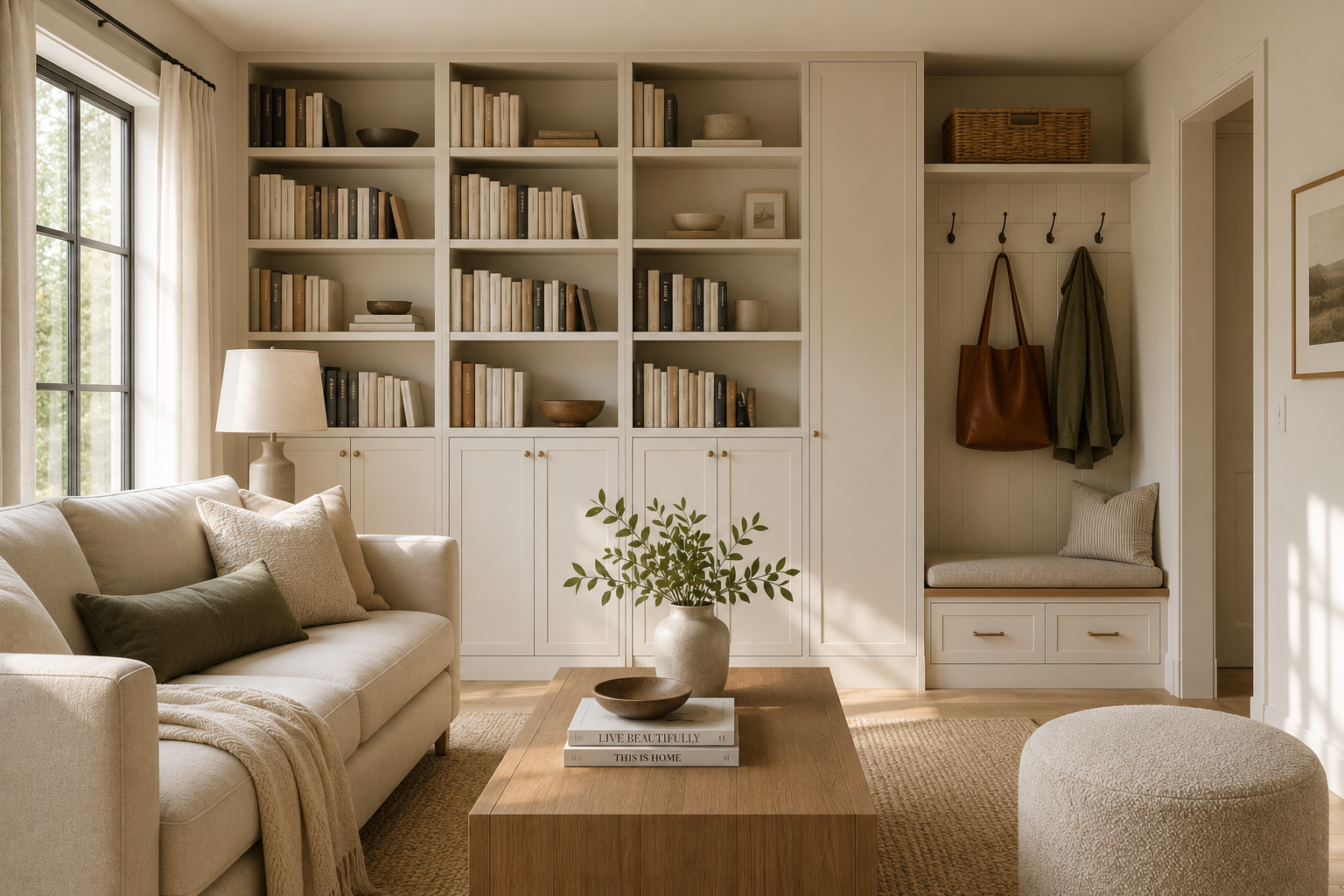
Whether you’re furnishing a dorm room, decorating your first apartment, organizing a townhouse, or simply trying to make a small room work better, these are the design principles I always come back to.
Stop Trying to Fit More Into Your Home
When people run out of space, the first instinct is usually to buy more organizers.
More baskets.
More bins.
More shelves.
I used to think the answer was adding more storage too.
Now I approach every room differently.
Instead of asking,
“How can I fit more into this room?”
I ask,
“How can this room work better?”
That one question completely changed how I design my home.
The best small spaces don’t feel bigger because they’re emptier—they feel bigger because everything has a purpose and every piece earns its place.
1. Buy Furniture That Works Harder
The best furniture solves more than one problem.
Instead of buying organizers after the fact, choose furniture that already includes storage.
Think:
- Storage ottomans
- Beds with drawers
- Entry benches with hidden storage
- Nightstands with drawers
- Lift-top coffee tables
When one piece serves two or three purposes, you naturally need fewer pieces overall. That leaves more open floor space, reduces visual clutter, and makes the room feel larger without changing its footprint.
🛒 Pepper Lu Picks

2. Go Up, Not Out
One of the biggest mistakes I see in small spaces is stopping storage at eye level.
Most rooms have an incredible amount of unused space between the top of your furniture and the ceiling. Instead of adding more furniture, use the full height of the room to create storage that actually works.
Tall bookcases are one of my favorite ways to do this. They naturally draw your eye upward, make ceilings feel taller, and provide significantly more storage without taking up additional floor space.
I’m also a huge fan of customizable storage systems like the IKEA PAX system. While most people think of it as a closet, it’s really a blank canvas. Because you can mix and match drawers, shelves, pull-out trays, hanging rails, baskets, and doors, you can customize it to fit almost any room in your home.
I’ve seen—and designed—PAX systems used for:
- Bedroom wardrobes
- Linen storage
- Entryway drop zones
- Laundry rooms
- Home offices
- Craft rooms
- Kids’ storage
- Mudrooms
- Pantry walls
The goal isn’t simply adding more storage.
It’s creating storage that fits your life instead of forcing your life to fit generic furniture.
Wall hooks still have their place, but I reserve them for the items I use every day—jackets, backpacks, keys, or the dog leash. If everything ends up hanging on hooks, they quickly become visual clutter instead of a functional system.
🛒 Pepper Lu Picks

3. Hide the Clutter
One of the quickest ways to make a small room feel larger is to reduce visual clutter.
That doesn’t mean stuffing everything into a basket.
It means designing storage so everyday items have a permanent home out of sight.
This is one of the biggest reasons I love drawers.
Unlike shelves or baskets, drawers bring everything to you. You can see what you own at a glance without digging through piles or moving things around. Whether it’s in a kitchen, bathroom, bedroom, or entryway, drawers make it easier to put things away—and just as easy to find them again.
Whenever I’m designing a space, I look for opportunities to replace open storage with hidden storage.
A cabinet with interior drawers is one of my favorite combinations. From the outside, it looks calm and uncluttered. Inside, every item has its own designated place. It’s the best of both worlds: clean lines with highly functional storage.
When everything has a home behind a door or inside a drawer, your room instantly feels calmer, more spacious, and much easier to maintain.
Baskets hide clutter. Drawers create homes.
🛒 Pepper Lu Picks
4. Drawers Beat Bins Every Time
If you’ve followed Pepper Lu Design for any length of time, you probably knew this one was coming.
Drawers are one of the best investments you can make in a small space because they work with you instead of against you.
Instead of kneeling on the floor and digging through a deep basket, the entire contents come to you with one pull.
No forgotten items hiding in the back.
No piles stacked on top of one another.
No rebuying something because you forgot you already owned it.
Whether it’s a pantry, bathroom vanity, laundry room, closet, or kitchen, I almost always choose drawers whenever I have the option.
They’re easier to organize.
Easier to maintain.
And far more enjoyable to use every day.

🛒 Pepper Lu Picks
5. Leave Empty Space
Not every corner needs something.
Not every shelf needs styling.
Not every countertop needs décor.
One of the biggest reasons small spaces feel crowded isn’t because they’re too small.
It’s because every available surface has been filled.
Instead of decorating every inch, let your favorite pieces breathe.
One beautiful lamp has more impact than five small accessories.
A single piece of artwork often feels more luxurious than a crowded gallery wall.
Sometimes the best decorating decision is choosing not to decorate at all.
The empty space around your favorite pieces is what allows them to stand out.
6. Give Everything a Home
Organization isn’t about putting things away.
It’s about knowing exactly where they belong before you need to clean up.
Think about the things you use every day:
- Keys
- Wallet
- Backpack
- Chargers
- Dog leash
- Laundry
If these items don’t have a permanent home, they’ll naturally end up on countertops, tables, or the nearest empty chair.
The easier it is to put something away, the more likely you’ll actually do it.
Good design doesn’t rely on willpower.
It creates systems that make the right choice the easiest one.
🛒 Pepper Lu Picks

7. Buy Less. Choose Better.
This is the design rule behind every decision I make.
Before bringing something into my home, I ask myself three simple questions:
- Does it solve a real problem?
- Will I still love it five years from now?
- Is it replacing something—or simply adding more?
Buying fewer, better things doesn’t just save money.
It creates calmer rooms.
Better organization.
Less clutter.
And a home filled with things you genuinely love instead of things you simply found space for.
If you’d like the exact buying filter I use before almost every purchase, you can download the free worksheet:
Buy Less. Choose Better. Love It Longer.
Final Thoughts
Small spaces don’t need more organizers.
They need better decisions.
Whether you’re furnishing a college dorm, decorating your first apartment, organizing a townhouse, or designing your forever home, these principles stay the same.
Start with function.
Design storage before you organize your belongings.
Choose furniture that earns its place.
Create homes for your everyday items.
Leave room to breathe.
Because when a room works well, it naturally becomes easier to keep organized—and that’s what makes a home feel bigger.
You May Also Like
- Design Your Storage Before You Organize Your Stuff
- The Function First Design Rule I Wish I Learned Sooner
- 5 Small Kitchen Ideas That Made the Biggest Difference
- I Replaced My Laundry Hampers With Hidden Drawers (And I’d Never Go Back)
Love,
Pepper