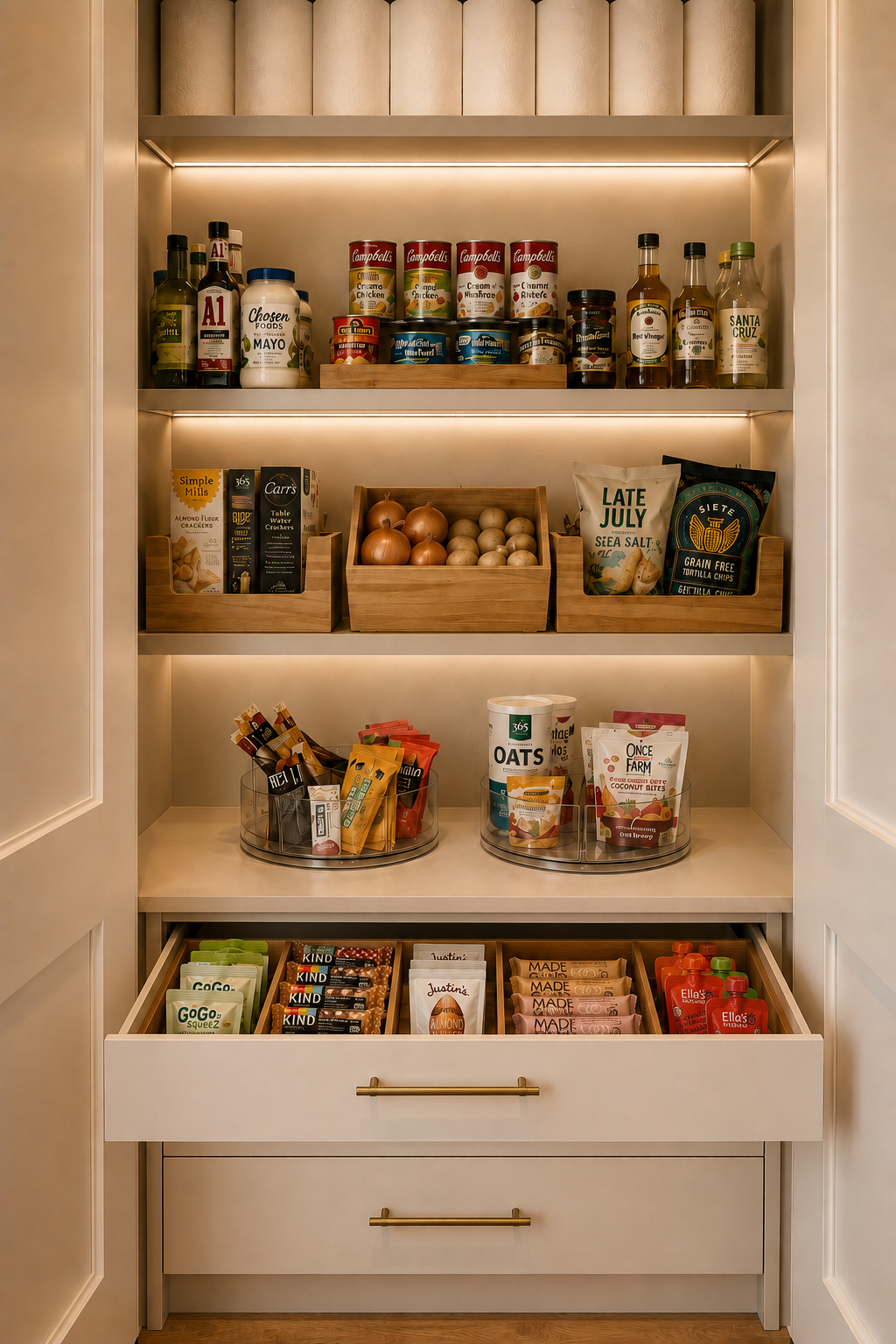
If you search for pantry organization ideas, you’ll find the same advice over and over again.
Buy matching bins.
Decant everything into clear containers.
Fill every shelf with baskets.
Label it all.
It looks beautiful in a photo.
But here’s the part no one talks about.
Your pantry is never going to look picture-perfect all the time.
If your family actually uses it, cereal boxes will be half empty, snacks will disappear, someone will leave a bag of chips on the wrong shelf, and grocery day will always look a little chaotic. That’s not a sign you’ve failed—it’s a sign your pantry is being lived in.
After redesigning my own pantry—and spending plenty of money on organizers that eventually ended up in my basement—I realized something.
The best pantries aren’t organized better. They’re designed better.
One of the biggest changes I made was completely rethinking the role of bins and baskets in my pantry. I Stopped Buying Pantry Bins and Organizers. Here’s What I Did Instead
A well-designed pantry doesn’t need constant resetting to look good. It works with the everyday mess of real life, making it easy to find what you need, put things away, and keep the space functional without chasing perfection.
Organization should be the last step, not the first.
The Pepper Lu Pantry Rule
Design your pantry for Tuesday night, not for Pinterest.
Your pantry should work when you’re unpacking groceries, packing lunches, cooking dinner, and helping your kids find a snack—not just five minutes after you’ve finished organizing it.
This post contains affiliate links. If you purchase through one of these links, I may earn a small commission at no additional cost to you. I only share products I use, genuinely recommend, or believe will help you create a home that is more functional, beautiful, and intentional. Thank you for supporting Pepper Lu Design.
Your Pantry Should Be Designed Around Your Family
One of the biggest mistakes I see is people designing their pantry around products instead of people.
Maybe your pantry is a small closet with five builder-grade shelves.
Maybe it’s a reach-in pantry that always feels too full.
Maybe you’ve never loved the layout but assumed you had to live with it.
That’s okay.
You don’t need a brand-new pantry to create a functional one.
You simply need to start looking at the space differently.
Instead of asking,
“How do I organize this?”
ask,
“How can this pantry work better for my family?”
Those are two very different questions.
Every family uses their pantry differently.
Maybe yours needs to hold school lunches every morning.
Maybe it’s full of bulk groceries.
Maybe your kids grab their own snacks.
Maybe you love baking.
The goal isn’t to recreate someone else’s pantry.
It’s to create one that makes everyday life easier.

Stop Thinking About Products. Start Thinking About Zones
The biggest mindset shift I made wasn’t buying better organizers.
It was creating better zones.
One of my favorite things about designing storage is that you don’t have to change the room to change how it works.
Sometimes simply moving snacks lower, grouping baking supplies together, or giving breakfast foods their own section completely changes how the pantry feels to use.
Instead of asking where your bins should go, ask yourself:
- What gets used every single day?
- What should kids be able to reach?
- Where should breakfast foods live?
- Which snacks are truly grab-and-go?
- What belongs somewhere else entirely?
The goal isn’t to create more storage.
It’s to make the storage you already have work harder.
Once everything has a purpose and a place, organizing becomes surprisingly easy.

Design Around Movement
A pantry isn’t something you admire.
It’s something you use.
Multiple times every single day.
Can you grab ingredients while cooking without moving three containers?
Can your kids put groceries away without asking where everything goes?
Can you quickly see what you’re running low on before heading to the store?
Can you reach everything without digging through layers of food?
The best pantry isn’t the prettiest one.
It’s the one that quietly makes everyday life easier.
Question Every Shelf
Before you buy another organizer, take a good look at the shelves you already have.
Could one shelf be removed to make room for taller appliances?
Could everyday items move lower so they’re easier to reach?
Could a deep shelf hold a lazy Susan instead of three baskets?
Could one section become dedicated snack storage?
Small layout changes often have a much bigger impact than buying more containers.
This is also one of the biggest reasons I love drawers.
Instead of stacking food behind more food, everything slides out into view. You can see what you have, reach everything easily, and waste far less space.
Sometimes replacing a few shelves with drawers creates a pantry that’s far more functional than adding another dozen baskets ever could.
Why Drawers Beat Baskets Every Time

Organize Last
Most pantry advice starts with shopping.
I think it should start with observation.
Empty your pantry.
Look at what you actually keep.
Watch how your family uses the space.
Move shelves if you can.
Create simple zones.
Live with that layout for a week.
Only then decide what organizers—if any—you actually need.
You might be surprised how much less you end up buying.

Pepper Lu Picks
Products That Earned Their Place
These aren’t products I recommend because they’re trending.
They’re products that solved a real problem in our home and continue to earn their place every single day.
IKEA Drawers (My #1 Recommendation)
Why they earned their place:
If I could recommend just one pantry upgrade, it would be drawers.
Unlike deep shelves, drawers bring everything to you. Nothing gets lost in the back, kids can reach what they need more easily, and you can see almost everything with one pull.
I chose IKEA drawers because they gave me the function I wanted without paying custom cabinetry prices. They completely changed how our pantry works.
- IKEA MAXIMERA Drawers
- IKEA SEKTION Cabinets (for pantry builds or renovations)
Drawer Dividers
Why they earned their place:
Once I added drawers, dividers were the finishing touch. They keep snacks, baking supplies, pouches, and pantry staples from sliding around every time the drawer opens.
Unlike bins, they’re flexible. As your pantry changes, the dividers can move with it.

Glass Pantry Jars
Why they earned their place:
I only use glass jars for ingredients we reach for constantly, like flour, sugar, oats, pasta, and cereal. They’re durable, easy to clean, and make it easy to see when it’s time to restock.
Lazy Susan
Why it earned its place:
A single turntable can completely transform a deep shelf. Oils, vinegars, sauces, and condiments stay visible and easy to grab instead of getting buried in the back.

Open Bamboo Produce Bin
Why it earned its place:
I use these for potatoes, onions, chips, and grab-and-go snacks. They keep everything visible and easy to access without adding unnecessary visual clutter.
Simple Pantry Labels
Why they earned their place:
Labels don’t create organization—they support it. I add them only after everything has found a permanent home.
A Pantry That Works Is Better Than One That Looks Perfect
Some of my favorite pantries aren’t the ones that look untouched.
They’re the ones that make life easier.
The ones where kids can grab a snack without pulling everything off the shelf.
The ones where grocery shopping is simpler because you can actually see what you have.
The ones that stay organized because they were designed well—not because someone spends an hour resetting them every weekend.
Perfection isn’t the goal.
Function is.
That’s why you’ll notice most of the pantries I share focus less on matching containers and more on thoughtful layouts, drawers, and storage that works for everyday life.
Because when your pantry is designed around the way your family actually lives, organization becomes something that happens naturally—not something you constantly have to maintain.

Related Reading
If you’re planning to rethink your pantry, these articles are a great place to read next:
- I Stopped Buying Pantry Bins and Organizers. Here’s What I Did Instead
- Why Drawers Beat Baskets Every Time
Love,
Pepper