Sometimes the best organization product isn’t another bin. It’s better storage.
This post may contain affiliate links. As an Amazon Associate, I earn from qualifying purchases. I only recommend products I personally use and love.
I Thought I Needed More Pantry Space
For years, I assumed my pantry was simply too small.
It isn’t a walk-in pantry.
It’s a standard reach-in pantry tucked just off our kitchen. It isn’t in the ideal location, so every trip to grab an ingredient means walking away from where I’m cooking. Because of that, every inch inside needed to work as efficiently as possible.
Like most people, I thought the answer was organization products.
More bins.
More baskets.
More containers.
The pantry looked organized…
…but it never actually worked.
I still found myself digging through shelves, moving containers around, and forgetting what was hiding in the back.
Then I realized something.
I didn’t need more pantry space.
I needed better storage.

Organized Doesn’t Always Mean Functional
My pantry wasn’t messy.
It was actually fairly organized.
The problem wasn’t clutter.
The problem was the shelves.
Deep shelves meant food disappeared behind other food.
Lower shelves required bending and digging.
Bins had to be pulled completely out just to reach something in the back.
I kept buying products to organize the shelves instead of questioning whether the shelves were the problem.
Eventually I realized something I now apply to almost every room in my home.
Just because a space looks organized doesn’t mean it’s functional.
I Thought Drawers Were Too Expensive
For years I avoided adding drawers because I assumed they were the expensive option.
Instead…
I bought bins.
Shelf dividers.
Containers.
More bins.
Replacement bins.
Storage baskets.
The three drawers I eventually installed cost about $300.
That sounded expensive…
…until I looked at the pile of organizers sitting in my basement.
By the time I added everything up, I had spent more trying to make shelves work than it cost to replace them with drawers.
That was a huge mindset shift.
Sometimes the expensive option is actually the one that saves money.

These drawers cost about $300. I’d already spent more than that trying to make shelves work.
Stop Buying Around the Problem
This pantry completely changed how I think about organization.
When something doesn’t work in our homes, we usually buy another product.
Another organizer.
Another basket.
Another bin.
We’re buying accessories to compensate for storage that was never designed well in the first place.
Sometimes the better investment isn’t another organizer.
It’s fixing the storage itself.
For me…
That meant replacing shelves with drawers.
The Reveal
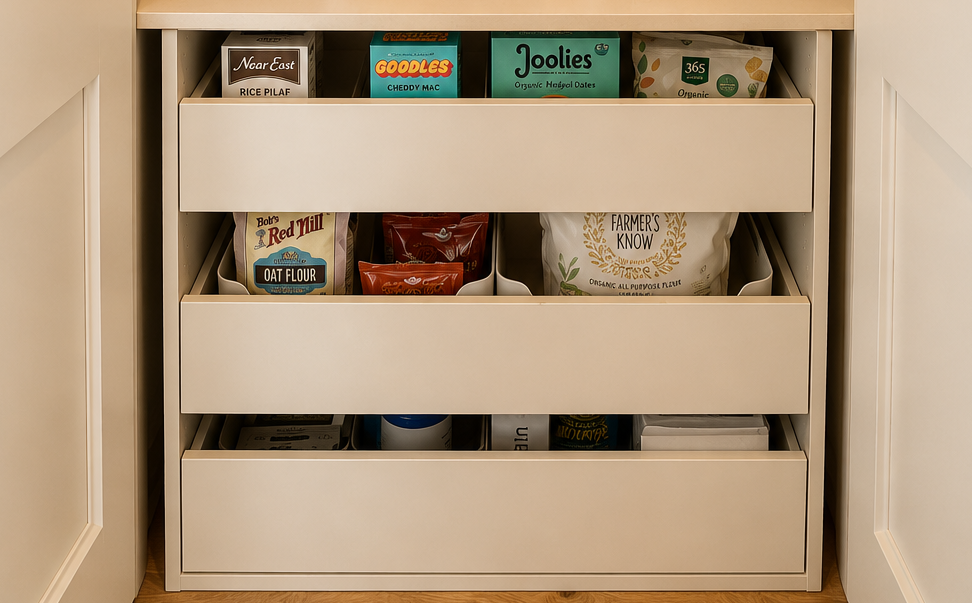
The biggest surprise wasn’t how organized the pantry looked afterward.
It was how much easier it became to use.
Everything has a home.
Nothing gets buried.
Nothing disappears.
And somehow…
The drawers aren’t even full.
For years I believed I had run out of pantry space.
It turns out I had simply run out of usable storage.

Every Zone Has One Job
One of the biggest improvements wasn’t adding drawers.
It was giving every shelf and drawer a purpose.
Top Shelf → Large or Rarely Used Items
The highest shelf is reserved for big things or things I rarely need.
- Paper towels
- Seasonal supplies
- Household overflow
- Lightweight bulk items
These don’t deserve prime storage space because I don’t use them every day.
Upper Shelves → Lazy Susans
The upper shelves are dedicated to Lazy Susans.
This is where I keep things like:
- Oils
- Vinegars
- Condiments
- Baking extracts
- Syrups
These categories usually have one bottle of each item.
Without a Lazy Susan, the mustard ends up hiding behind the ketchup.
The vinegar disappears behind the olive oil.
With one quick spin, I can see everything.
I don’t need more storage.
I just need visibility.

Eye Level → Foods I Want to See
Eye level is reserved for foods where seeing everything matters.
This includes:
- Potatoes
- Onions
- Garlic
- Crackers
- Chips
- Lunch foods
These are the foods we reach for throughout the day.
Keeping them visible makes choosing quick and easy.

Lower Shelf → Grab-and-Go Snacks
The shelf just above the drawers is dedicated to snacks.
It’s the first place we look when packing lunches or grabbing something quickly.
Simple.
Easy.
Exactly where it belongs.

Top Drawer → Everyday Cooking
The top drawer holds the foods I cook with most often.
- Rice
- Pasta
- Grains
- Dinner sides
Unlike shelves, drawers allow similar items to stand upright instead of stacking them.
I can see everything immediately.
Nothing gets buried behind another box.

Bottom Drawers → Backstock
The lower drawers are reserved for items we don’t use every day.
Things like:
- Extra flour
- Extra oats
- Baking ingredients
- Refill products
- Pantry backstock
Before, these competed with everyday ingredients for shelf space.
Now they’re easy to find without getting in the way.

Drawers Remove the Need for “Pinterest Perfect”
One thing I didn’t expect after installing drawers was how much less I cared about making my pantry look perfect.
For years, I thought organization meant matching containers.
Matching labels.
Perfectly decanted pasta.
Beautiful rows of identical jars.
That’s the version of pantry organization we see all over social media.
But it’s also expensive.
And honestly…
It’s hard to maintain.
With drawers, I don’t need visual perfection because the storage itself does the work.
Boxes can stay in their original packaging.
Pasta can stay in the bag it came in.
Rice doesn’t have to be transferred into another container.
Coffee stays in its bag until I’m ready to use it.
The drawer slides open, everything stands upright, and I can immediately see what I have.
The organization comes from visibility, not matching containers.
Function Over Aesthetics
Don’t get me wrong—I still appreciate a beautiful pantry.
I use clear Lazy Susans because they make bottles easier to see.
I use simple white bins to group backstock.
I use wooden produce bins because they’re practical and breathable.
But every organizer in this pantry has a job.
Nothing is here simply because it looks pretty.
That’s a big shift from the way I used to shop.
I stopped asking:
“Will this make my pantry look organized?”
And started asking:
“Will this make my pantry easier to use?”
Surprisingly, once I focused on function first…
The pantry naturally became more beautiful.
I Didn’t Gain More Space
I Gained More Usable Space.
This is still the same small pantry.
Nothing about its size changed.
But somehow…
I have room to grow.
The drawers aren’t even full.
That’s because shelves waste more space than we realize.
When everything becomes visible and accessible, you naturally use the entire cabinet more efficiently.

This System Works Even If You Don’t Have a Pantry
One thing I love about this design is that it isn’t limited to homes with a pantry.
This exact layout could be recreated using a 30-inch IKEA pantry cabinet, making it a great option for homes, apartments, or condos without a dedicated pantry.
Whether you choose the approximately 80-inch or 90-inch version, the same principles apply.
- Rarely used items on top.
- Lazy Susans for bottles.
- Eye-level visibility.
- Drawers for everyday cooking.
- Backstock below.
Sometimes you don’t need a pantry.
You just need one cabinet that’s designed well.
🛒 AFFILIATE LINKS
My Dream Pantry Looks Different
If I were building my forever home, this wouldn’t be my dream pantry.
My dream pantry would function almost like a second kitchen.
A place where:
- Small appliances stay plugged in and ready to use.
- Baking projects can happen without taking over the kitchen counters.
- Costco-sized backstock has a dedicated home.
- Meal prep happens without taking over the main kitchen.
That’s a workspace.
This pantry has a different job.
It’s designed to support everyday cooking.
It stores the foods we reach for while making dinner or packing lunches.
And for that purpose…
It works beautifully.
Final Thoughts
This project reinforced something I believe about almost every room in a home.
Storage isn’t about fitting more things into a space.
It’s about making the things you already own easier to use.
That’s why every zone has one purpose.
- Least-used items live on the highest shelf.
- Bottles belong on Lazy Susans.
- Foods you want to see stay at eye level.
- Grab-and-go snacks live just above the drawers.
- Everyday cooking ingredients belong in the top drawer.
- Backstock stays tucked away below.
I didn’t organize my pantry by buying more organizers.
I organized it by designing better storage.
And I honestly don’t think I’ll ever go back.
Related Reading
➡ Why Drawers Beat Baskets Every Time
➡ Your Home Doesn’t Need More Storage—It Needs Better Storage
➡ Design Your Storage Before You Organize Your Stuff
📥 Free Resource
Before buying another organizer, download my Buying Filter Worksheet. It will help you determine whether you’re solving the real problem—or just buying around it.
📖 Want to Create a More Functional Home?
If you’ve ever bought organizer after organizer but still felt like your home wasn’t working, you’ll love my guide.
It’s packed with the mindset shifts and practical decisions that have helped me spend less, buy better, and create a home that works harder every day.
Love,
Pepper