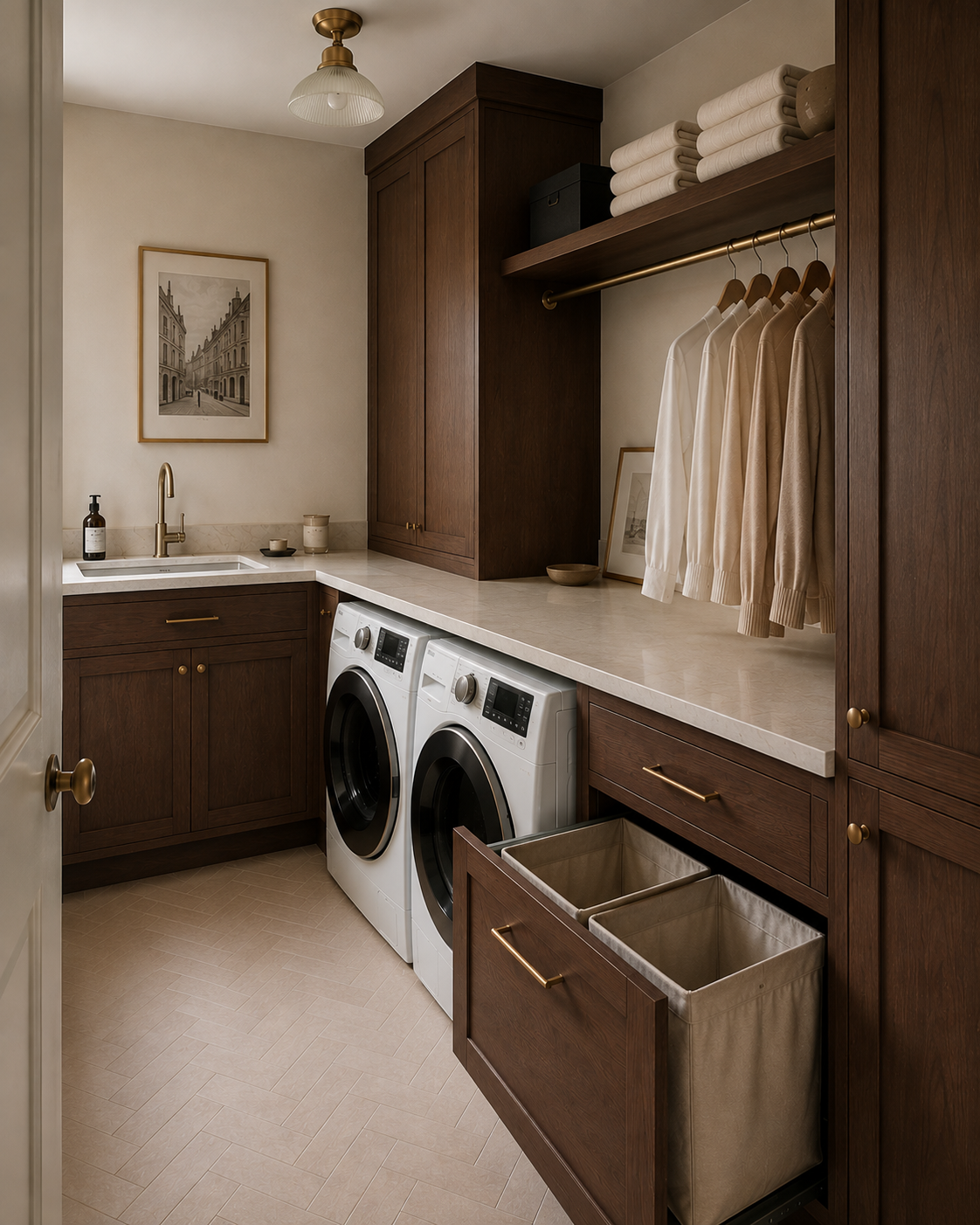
There isn’t one perfect laundry room layout.
A laundry room with built-in hampers, a huge folding counter, a sink, and an ironing station might be incredibly functional for one household—and full of unnecessary features for another.
Before deciding what belongs in your laundry room, start with two things:
Where is the laundry room located, and how do you actually do laundry?
Those answers should determine the layout.
This post may contain affiliate links. As an Amazon Associate, I earn from qualifying purchases at no additional cost to you.
Where Does Your Dirty Laundry Actually Live?
Start with where dirty clothes accumulate.
If most dirty laundry stays in bedroom hampers until laundry day, you may not need multiple large hampers taking up valuable space in the laundry room.
But maybe clothes regularly land there. Maybe kids come through a nearby mudroom and change out of dirty clothes. Maybe kitchen towels, cleaning cloths, and other household laundry accumulate there throughout the day.
In that case, built-in hamper drawers could be some of the most useful storage in the room.
Don’t add hampers because every dream laundry room seems to have them.
Figure out where your dirty laundry naturally collects first.

Where Do You Iron or Steam Clothes?
The answer might not be the laundry room.
If your laundry room is close to your bedroom or closet, keeping an ironing board or steamer there may make perfect sense.
But if the laundry room is on another floor, would you really walk downstairs every morning to steam the shirt you just pulled out of your closet?
Probably not.
If you’ll actually iron or steam in the laundry room, design for it: an outlet in the right location, a place to hang the garment, storage for the steamer, and enough room for an ironing board to open without blocking the space.
If you’ll actually do those things near your closet, don’t dedicate valuable laundry-room space to them.

Do You Have a Top-Load or Front-Load Washer?
Your appliances completely change your available work surface.
Front-loading machines give you the opportunity to run a continuous countertop over the washer and dryer, creating a large folding surface without using additional floor space.
A top-load washer doesn’t.
That doesn’t make a top loader less functional. It simply means your folding space needs to be planned differently if you want to fold laundry in the room.
Which brings us to the more important question.

Where Do You Actually Fold Laundry?
Some people take everything out of the dryer, fold the entire load on a large countertop, sort it, and then carry everything back to the bedrooms.
Others bring clean laundry upstairs and fold it near the dresser or closet, putting items away as they go.
Those two people don’t need the same laundry room.
If you fold every load in the laundry room, generous uninterrupted countertop space should be a priority.
If you prefer to fold clothes where they’re ultimately stored, an enormous laundry-room counter may be unnecessary. A smaller surface for sorting or setting down a basket might be plenty.
The goal isn’t to create as much countertop as possible.
It’s to create as much as you’ll actually use.

Let Your Routine Design the Room
Before adding cabinetry, hamper drawers, folding counters, ironing stations, or any other feature, follow a load of laundry through your home.
Where does it start?
Where does it collect?
Where is it washed?
Where do you fold it?
Where do you iron or steam?
Where does it ultimately need to go?
That path should determine what earns space in the room.
You might discover that built-in hampers are essential—or completely unnecessary. You might need an entire wall of folding space or only a small counter. Your steamer might belong in the laundry room, or it might make far more sense near your closet.
There isn’t a universal list of features that makes a laundry room functional.
A functional laundry room is one designed around the way you actually use it.

Function first. Beauty second. Always both.
Love,
Pepper