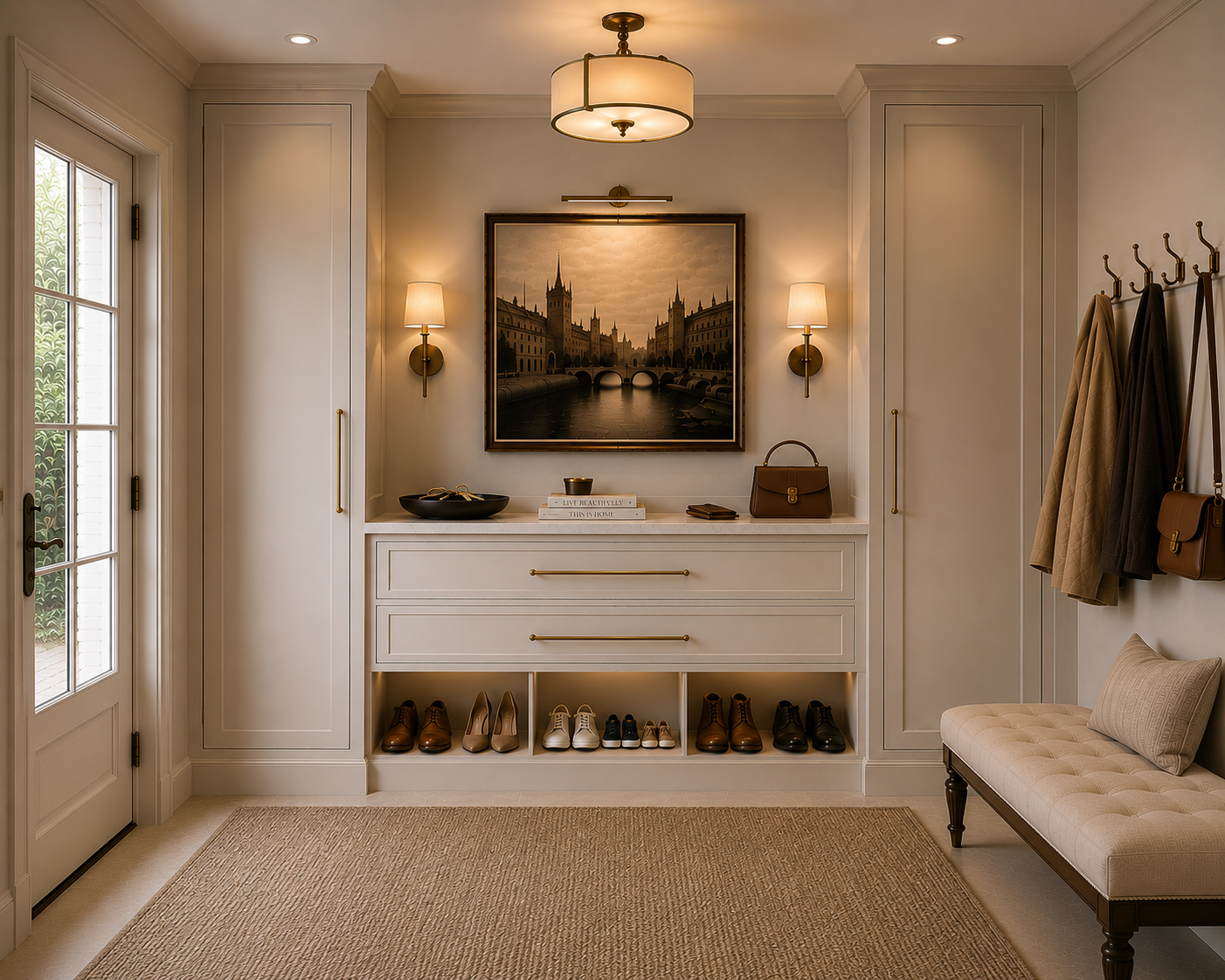
An entryway has one job that matters more than looking pretty: it needs to make coming home and leaving easier.
This is where shoes come off. Coats get dropped. Keys disappear. Backpacks hit the floor. Groceries come through the door. Someone realizes they forgot their sunglasses after they’re already halfway outside.
And yet, entryways are often designed as decorative spaces first.
A console table. A mirror. A lamp. Maybe a basket underneath.
They look beautiful in photos, but they don’t necessarily solve any of the things that actually happen at the door.
A functional entryway should be designed around your come-in, go-out routine. Everything your family regularly needs when entering or leaving the house should have a logical home here—and it should be just as easy to put those things away as it is to drop them on the floor.
Start With the Door Your Family Actually Uses
The formal front door isn’t necessarily your home’s real entryway.
If your family regularly comes through a garage, side entrance or mudroom, that’s the space that needs to do most of the work.
Ideally, I like a family entrance or mudroom located near the kitchen. When you’re carrying groceries, takeout, lunch bags or a sleeping child through the door, you shouldn’t have to walk across the house to reach the kitchen.
But location is only part of it.
Think through what happens from the moment you walk inside:
Shoes come off.
Coats come off.
Keys and wallets get put down.
Bags need somewhere to go.
Wet boots need somewhere to dry.
And when you leave, you need to be able to reverse that process without searching through the house for everything you need.
Design around that sequence.
Principles of a Functional Home
Everyday Coats Should Be Easy to Put Away
Not every coat belongs hidden inside a coat closet.
The jackets your family wears every day should have hooks in the family entry or mudroom.
Hooks remove friction. Walk in, take off your coat and hang it up.
That’s it.
If putting away a child’s jacket requires opening a cabinet, finding a hanger, putting the coat on the hanger and hanging it on a rod, there’s a pretty good chance that jacket is going to end up somewhere else.
Save the tall closed cabinetry for additional coats, seasonal jackets and things you don’t need every single day.
Daily items should be the easiest things to access—and the easiest things to put away.
Give Everyday Shoes an Open Home
I’m not a fan of throwing everyday shoes into a big basket.
Now you have to dig through a pile to find the pair you want.
Instead, I prefer open shoe shelves for the shoes your family reaches for constantly.
Under a bench is a perfect place for them because it combines two functions: you can sit down to put on your shoes, and the shoes are directly below you.
But the bench and shoe storage don’t have to be connected.
If your layout works better with a bench on one wall and shoe storage on another, separate them. Function matters more than creating the perfect built-in moment.

Design Your Storage Before You Organize Your Stuff
Store the Rest of the Shoes Vertically—and Make Them Visible
The shoes you don’t wear every day can move into tall cabinetry, but I still want them to be easy to see.
One of my favorite solutions is deep pull-out shoe trays.
Instead of lining one row of shoes across the front of a deep cabinet and losing everything behind them, a pull-out tray allows you to use the full depth. Multiple rows can sit front to back, and when you pull the tray out, you can actually see what you own.
This is especially useful when you’re trying to maximize storage without filling the room with cabinetry.
And add a light inside the cabinet.
It’s a small detail, but being able to actually see what’s stored in a deep cabinet makes that storage considerably more useful.

Create a Real Drop Zone
There are some things you genuinely need to put down when you walk through the door.
That’s why I like incorporating a small countertop into an entryway or mudroom.
This is where your keys can land.
Your wallet.
Your everyday purse.
Maybe the mail you just brought inside.
The difference between a functional drop zone and a cluttered console table is what happens next.
Everything that regularly lands on that counter should have a permanent home within arm’s reach.
Put the Quick-Grab Things in Drawers
Directly underneath that countertop, give yourself drawers.
These are perfect for the small things you regularly need on your way out:
- Sunglasses
- Chargers
- Earbuds
- Portable batteries
- Spare keys
- Other small everyday essentials
They’re close enough to grab quickly, but they’re not sitting on the counter creating visual clutter.
And then give seasonal accessories their own drawer.
Hats, mittens, gloves and scarves are much easier to use when you can open a drawer and see everything at once instead of digging through a deep basket.
Drawers are especially helpful for kids because they can see what they have, grab what they need and put it away themselves.

The Secret to an Organized Home Isn’t More Bins
Plan for Wet Boots, Mud and Snow
If you live somewhere with real winters—or even just a lot of rain—the entryway has to be designed for what comes in on your feet.
Beautiful flooring that can’t tolerate wet boots isn’t functional.
Choose flooring appropriate for water, mud, salt and snow, especially at the family’s primary entrance.
Then create a designated place for wet footwear.
Boot trays, dedicated boot storage or an area where wet shoes can sit without damaging cabinetry or flooring should be planned into the room rather than added as an afterthought.
And don’t underestimate the importance of a good entry mat.
The goal is to stop as much dirt and water as possible before it travels farther into the house.
Don’t Forget About Your Guests
This is one of the biggest things I think gets overlooked when designing an entryway.
Your family may enter through the mudroom every day while your guests come through the front door.
That means both entrances need to function.
When someone walks into your home, it should be immediately obvious what they’re supposed to do with their coat, shoes and belongings.
For coats, I love clear, visible hooks.
Guests don’t need instructions. They don’t need to ask where their coat should go. They can walk in and hang it themselves.
A coat closet can absolutely work too—but think about how you actually entertain.
If you greet every guest at the door and take their coat yourself, a closet makes sense.
If you don’t, visible hooks are easier.
And if you have a coat attendant, congratulations. You may disregard this entire problem.
Guests also need an obvious place for shoes if yours is a shoes-off home, along with somewhere to temporarily put a purse or other belongings.
You shouldn’t have to relocate your family’s things every time someone comes over to make room for guests.
Design guest storage intentionally from the beginning.

The Entryway Should Help You Leave the House
We tend to think about entryways as places for putting things away.
They’re equally important when you’re trying to get out the door.
Think about what you routinely need before leaving:
Your shoes.
Coat.
Keys.
Wallet.
Purse.
Sunglasses.
Kids’ backpacks.
Hats and mittens.
Whatever else belongs to your family’s routine.
The more of those things that can live logically near the exit, the less running around the house you have to do before leaving.
You’re essentially creating a physical checklist.
Shoes? Right there.
Coat? On the hook.
Keys? On the counter.
Sunglasses? First drawer.
Mittens? Second drawer.
Everything has a home because everything has a job.
A Functional Entryway Isn’t About Adding More Storage
More cabinetry doesn’t automatically create a more functional entryway.
The goal isn’t to fit as much stuff as possible into the room.
The goal is to put the right storage in the right place for the right things.
Everyday coats need hooks because they’re used constantly.
Occasional coats can live behind doors.
Everyday shoes need quick-access shelves.
Additional shoes can live on deep pull-out trays.
Small essentials need shallow drawers where you can see them.
Wet boots need materials that can handle them.
Guests need storage that makes sense without knowing your family’s system.
And all of it should work together to make the two things you do at this space every single day easier:
Come in. Go out.
That’s what a functional entryway is supposed to do.
Love,
Pepper